The kind stepdaughter and the giant's casket
Who is in the tale?
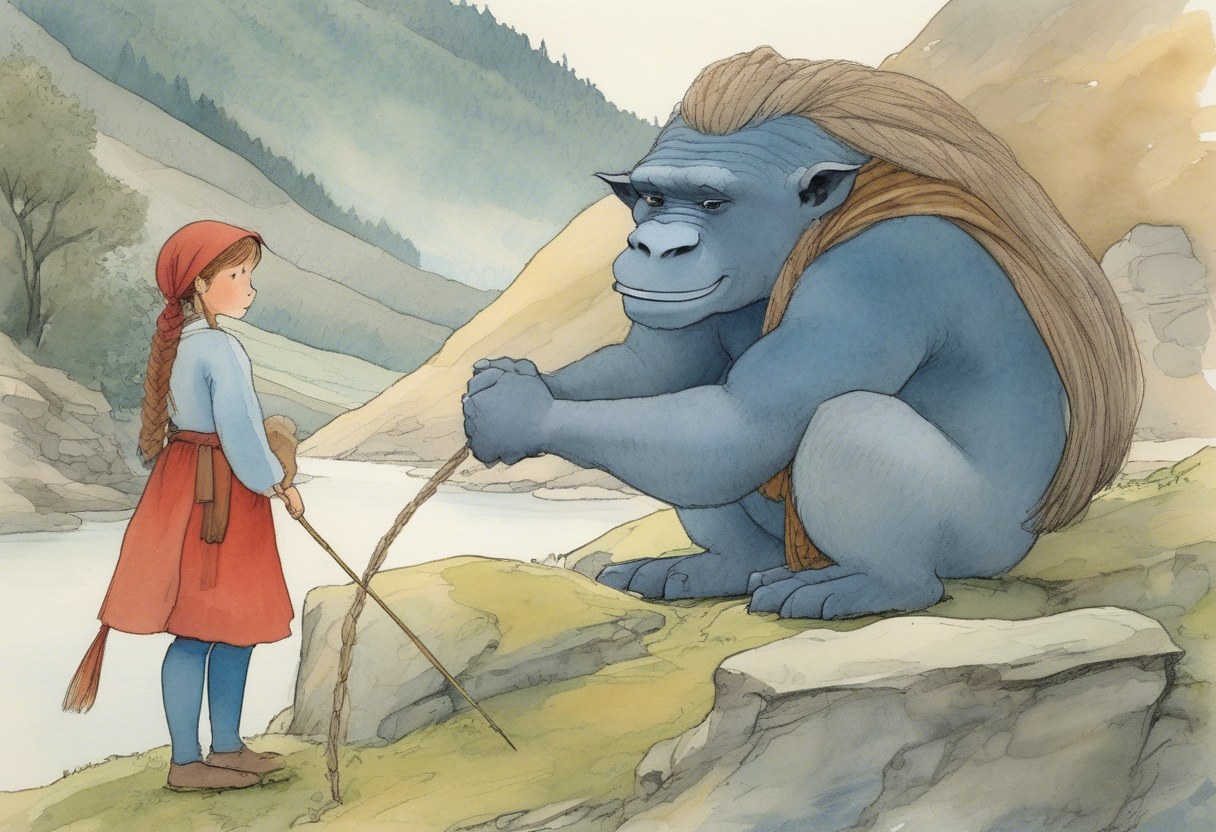
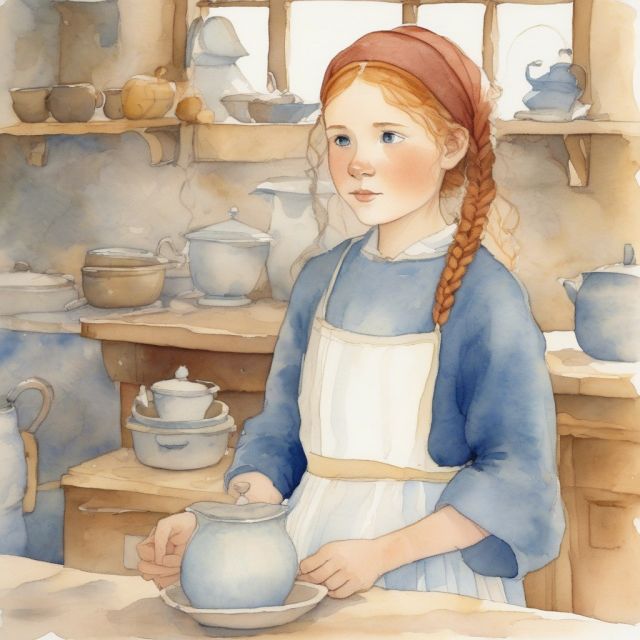 RagnaThe kind stepdaughter who works for the giant
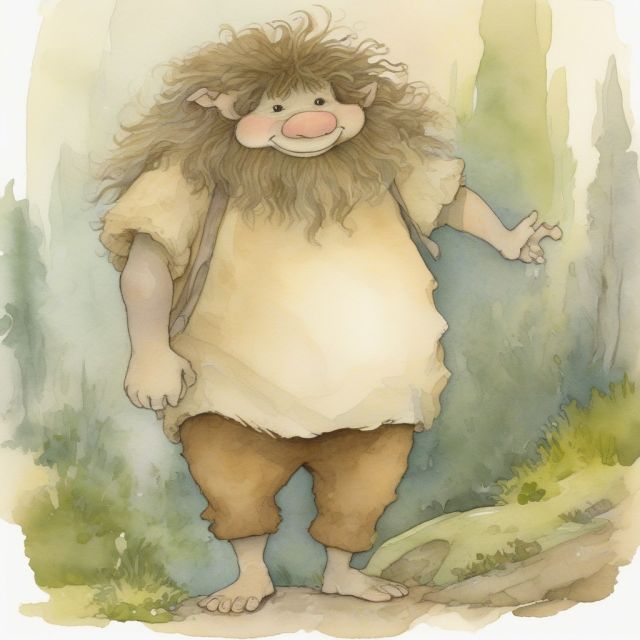 JutulenThe big grumbling giant who pays in boxes
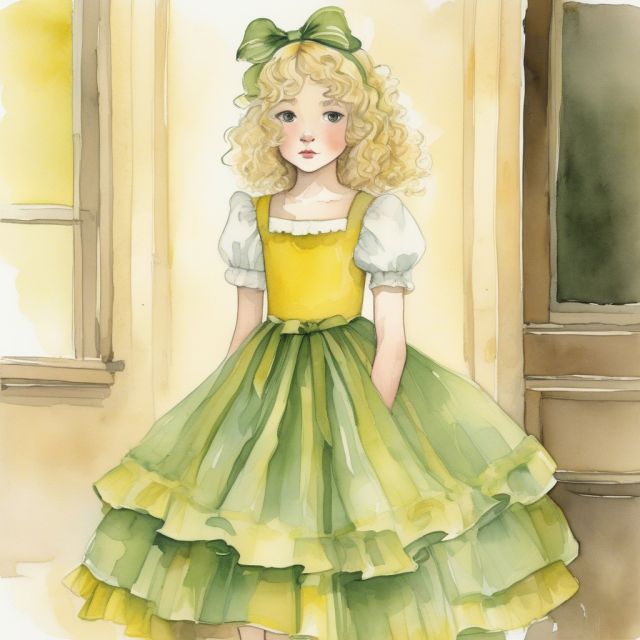 GunhildThe stepmother's unkind daughter
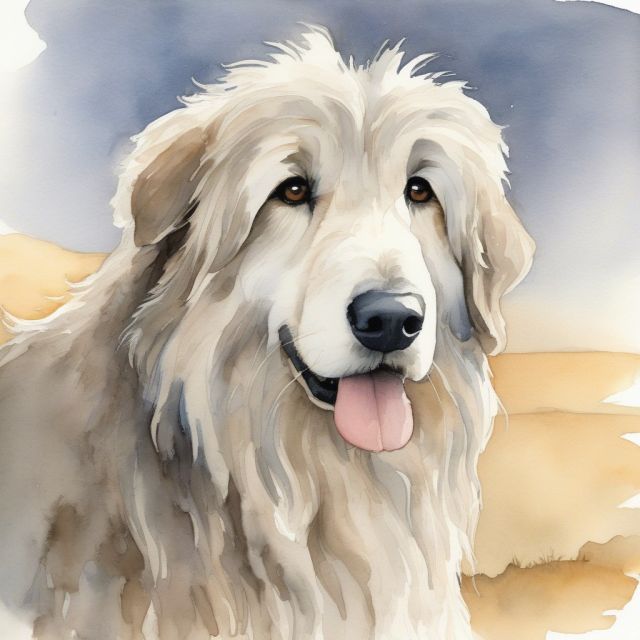 BrageThe farm dog who helps Ragna escape
An empty grain chest
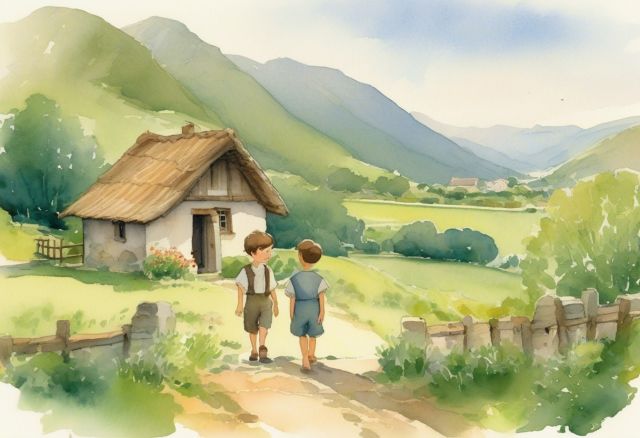
Once upon a time there was a girl called Ragna. Her mother had died when she was little, and her father had married again, to a woman who already had a daughter. The daughter was called Gunhild. The stepmother was as hard as frozen ground, and everything that was good and warm and pretty went to Gunhild.
Ragna carried water from the brook, scrubbed the floors, milked the goats and baked flatbread until her fingers were red. Gunhild sat against the sunny wall, plaiting ribbons into her hair. "Ragna, I'm thirsty!" she called. "Ragna, you've forgotten to fold my bedspread!" And Ragna never said no. She was simply the sort of girl who would rather do one favour too many than one too few.
Then came a year with rain in the summer and early frost in the autumn. The corn rotted in the field, and soon there was nothing left in the grain chest but mice, and they looked disappointed. The stepmother folded her arms and said, "There isn't enough food for everyone. A girl who is big enough to eat is big enough to earn her own bread. Ragna, you must go and find work with strangers."
Her father opened his mouth, but no words came out. He only gave her a heel of bread and her mother's little comb made of horn. "God go with you, daughter," he said quietly. "Be as kind out in the world as you have been at home."
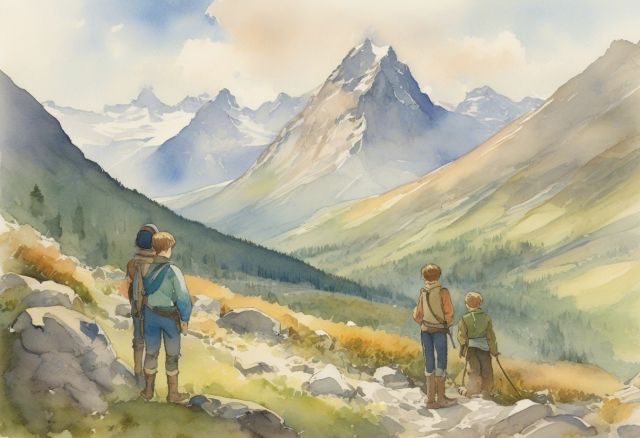
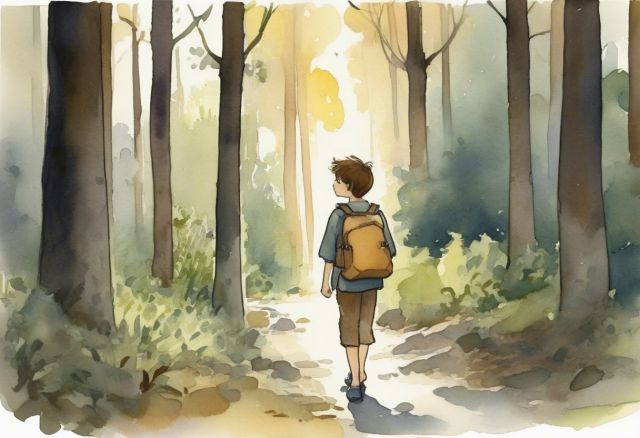
Ragna walked up the valley, past summer farms and sheep, along a river that sang over the stones. The mountains rose bigger and bluer with every step, for she was heading deep into Trollheimen. When evening came and her legs were heavy, she saw a light. It shone beneath a steep cliff, beside a dark tarn, and it came from a farm so big that it looked almost like a little mountain with a turf roof.
The farm under the cliff
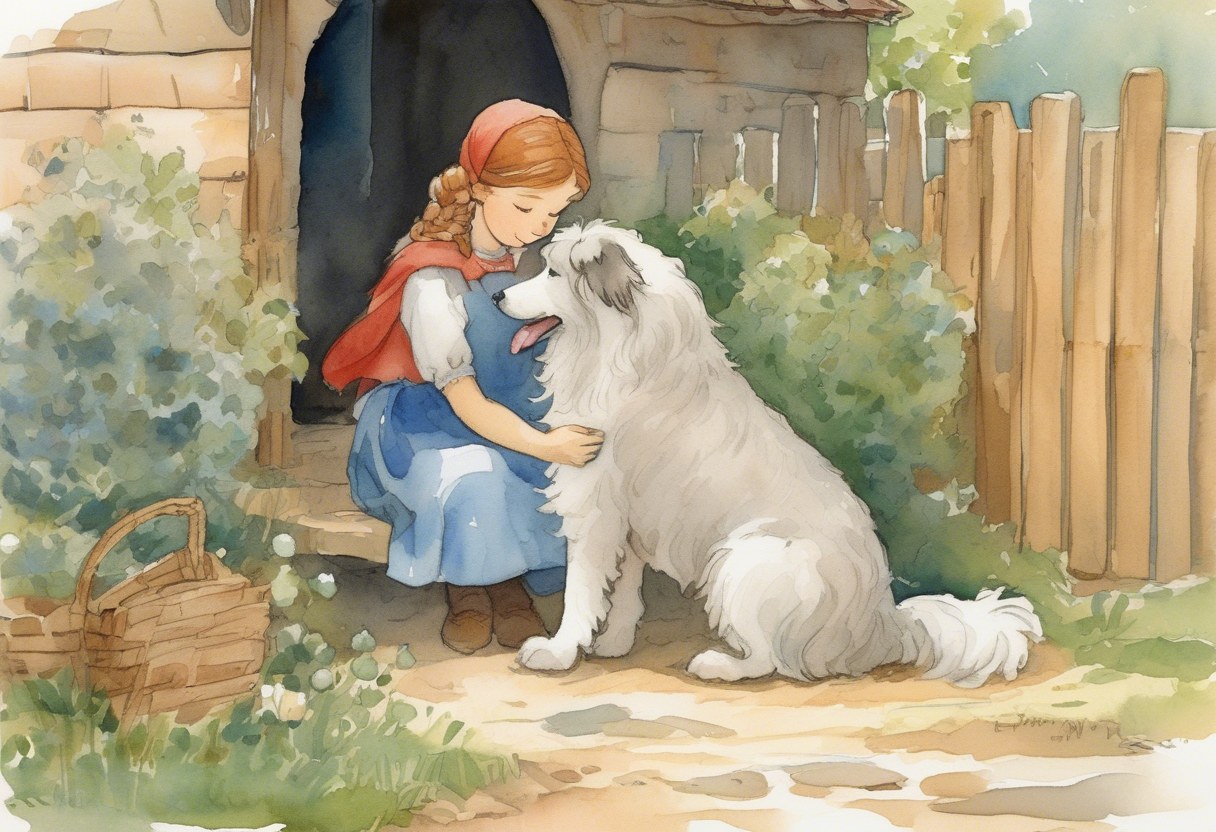
Ragna knocked on the gate, and it swung open with a rumble. Outside stood a giant. He was as big as a boulder, with moss on his shoulders, heather in his shaggy hair and a nose like an enormous potato. He looked at her with small, round eyes.
"Hm," he said. "Is that a girl? I need someone who can light the fire, bake and look after the animals while I'm out on the mountain. Can you do that?"
"I can certainly try," said Ragna. Her heart was pounding, but her voice stayed calm.
"Good. You may stay until the first snowfall. For your wages, you shall choose one casket from my parlour. One casket, not two, and don't get greedy." Then he went out into the darkness with heavy, thumping steps, and the tarn trembled after him.
The next morning Ragna walked around the farm and found out who really lived there. In the cowshed stood an old cow called Rosa, with a full udder and an empty manger. No one had looked after her for a long time. Ragna fetched hay, milked her gently and scratched her behind the ear. Rosa let out a breath like a little bellows.
By the kennel lay a big, scruffy dog called Brage. His coat was full of tangles, and his water bowl was empty. Ragna combed him with her mother's comb, tangle after tangle, and fetched him fresh water. And up on the roof sat a crow with a broken wing, too afraid to fly. Ragna made a little bandage out of linen and fed her breadcrumbs.
Worst of all was the kitchen. There, under the bench, sat three little gnomes with grey faces and beards of grey wool. They were hunched over and shivering. "We're not used to being noticed," whispered the smallest one. "The giant says we get in the way. And we're so hungry."
Ragna had only a little bread left, and her tummy was already rumbling. It was a hard choice. But then she broke the heel into four equal pieces, one for each of the gnomes and one for herself. "We'll each have a little," she said, "and then no one will be quite empty." From that day on she always put out a bowl of porridge under the bench. The gnomes peeped out, and soon they were sitting on the rims of the pots, telling her everything they knew about the farm.
Three caskets on the table
The weeks went by, and Ragna put the farm in order. The floors were scrubbed, and the firelight danced on shining kettles. Rosa gave plenty of milk, Brage wagged his tail so hard that it thumped against the wall, and the crow very nearly flew a little loop every day. The gnomes learned to laugh.
Then one morning a white blanket of snow lay over the tarn, and the giant came in with snow in his beard. "First snowfall," he grumbled. "You've done a good job, girl. Here are the caskets." He set three caskets on the table.
The first was made of shining gold, with red stones that glowed like rowan berries. The second was silver, so fine that Ragna could see her face in the lid. The third was a plain grey casket made of birch bark, tied with a bast cord. It looked like something forgotten on a cellar shelf.
Ragna stood and looked for a long time. The golden casket was tempting. She thought of her father, of the leaking roof and the empty grain chest. But from the floor came a whisper. "Take the grey one," said the smallest gnome, hardly moving his lips. Brage tilted his head and whimpered softly, as if he wanted to say the same.
"I'll take the grey one," said Ragna out loud. "It's the one I can manage to carry all the way home, and I don't really need anything fancy."
The giant looked at her and blinked his round eyes. "Not many people make that choice," he said slowly. "But don't open it until you are standing in your own parlour." Then he turned away and went out again, and Ragna heard his footsteps suddenly grow quicker and more restless.
"You must go now," the gnomes squeaked. "He's the sort who changes his mind. He never meant to give away the grey casket, for it is the best of them all!"
The flight across the bog
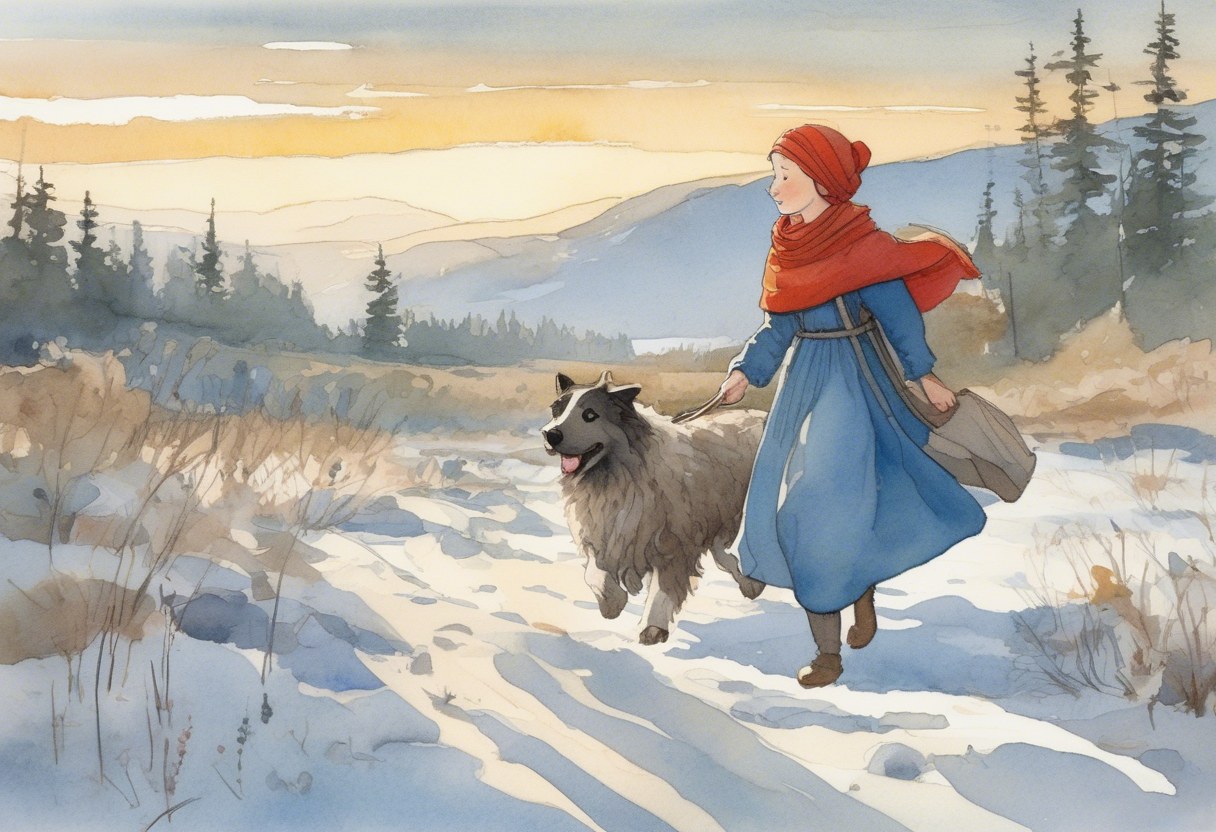
Ragna tucked the casket under her arm and ran out into the cold morning. She hadn't got far across the yard before she heard it behind her. Thump. Thump. Thump. The trees shook, and snow showered down from the branches. "Where do you think you're going with my casket?" thundered the giant. "I've thought better of it! Come back!"
Then they all joined in. Ragna had no time to say thank you or goodbye. Brage dashed past her with flapping ears and shouted, "Follow me! I know the path through the bog!" And the crow flew straight up and landed on the giant's head, with her bad wing stretched out, and screeched so loudly that he lost both his hat and his sense of direction.
By two big stones, where the path grew as narrow as a pinprick, stood Rosa. She had broken out of the cowshed door and now stood in the middle of the path, her sides heaving and her gaze calm. The giant stopped and tried to squeeze past. "Move, cow!" But Rosa only chewed and shook her head. She didn't budge an inch until Ragna was far up the hillside.
Brage led her out onto the bog, where the grass looked firm but the ground underneath was dangerous. He hopped from tussock to tussock, and Ragna followed, stepping exactly where he had put his paws. The three gnomes had slipped away through a cellar hatch and popped up by the brook. There they stood, tugging at a thick tuft of reeds, so that it pulled the giant's foot straight down into the mud. Squelch! He was stuck up to his ankles.
"Help! You'll be sorry for this!" he shouted, struggling. But at that very moment the sun rose behind the peaks of Trollheimen and spilled its golden light over the whole hillside. The giant looked at the light, then at the girl, who was now just a tiny speck far away, and sighed so heavily that the moss cracked on his shoulders. "Oh, very well," he muttered. "Let her go. She was the only one who ever combed my dog, at any rate."
Ragna didn't hear his last words. She only heard a deep, distant rumbling and thought it might be the wind. She made her way down the valley with the casket held tight against her chest, and Brage ran beside her all the way to the edge of the village. There he gave her hand one last lick and turned for home.
Gold and toads
When Ragna came into the parlour, her father was sitting at the table with his face in his hands. He stood up so quickly that his chair toppled over. "Ragna! You're alive!" And he gave her such a big hug that they both had to wipe their eyes.
Then she put the casket on the table and untied the bast cord. The lid came open, and it glittered so brightly that the stepmother put her hand over her mouth. The casket was full of gold coins, silver clasps and little rings with stones that shone like stars. Ragna made sure her father got a new roof and a full grain store, and that everyone in the village who was cold received firewood and flour.
But the stepmother could not forget the casket. "If Ragna can get so much," she said to Gunhild, "you can get even more. You shall go up to the giant and choose the very best." Gunhild laughed out loud and said it was the easiest thing she had ever heard.
At the giant's farm, things did not go so well. She kicked at Brage because he smelled of dog. She told Rosa she was ugly and sour. She chased the gnomes away with a broom, and she burned the porridge on the hearth because she couldn't be bothered to stir it. As for the crow, she said she would make soup of her.
When the first snowfall came, the giant set the three caskets on the table again. Gunhild grabbed straight for the gold one with the red stones. No one whispered to her. No one whimpered. She took the casket and left without saying thank you, and the giant let her go. Brage didn't wag his tail, and the gnomes didn't peep out.
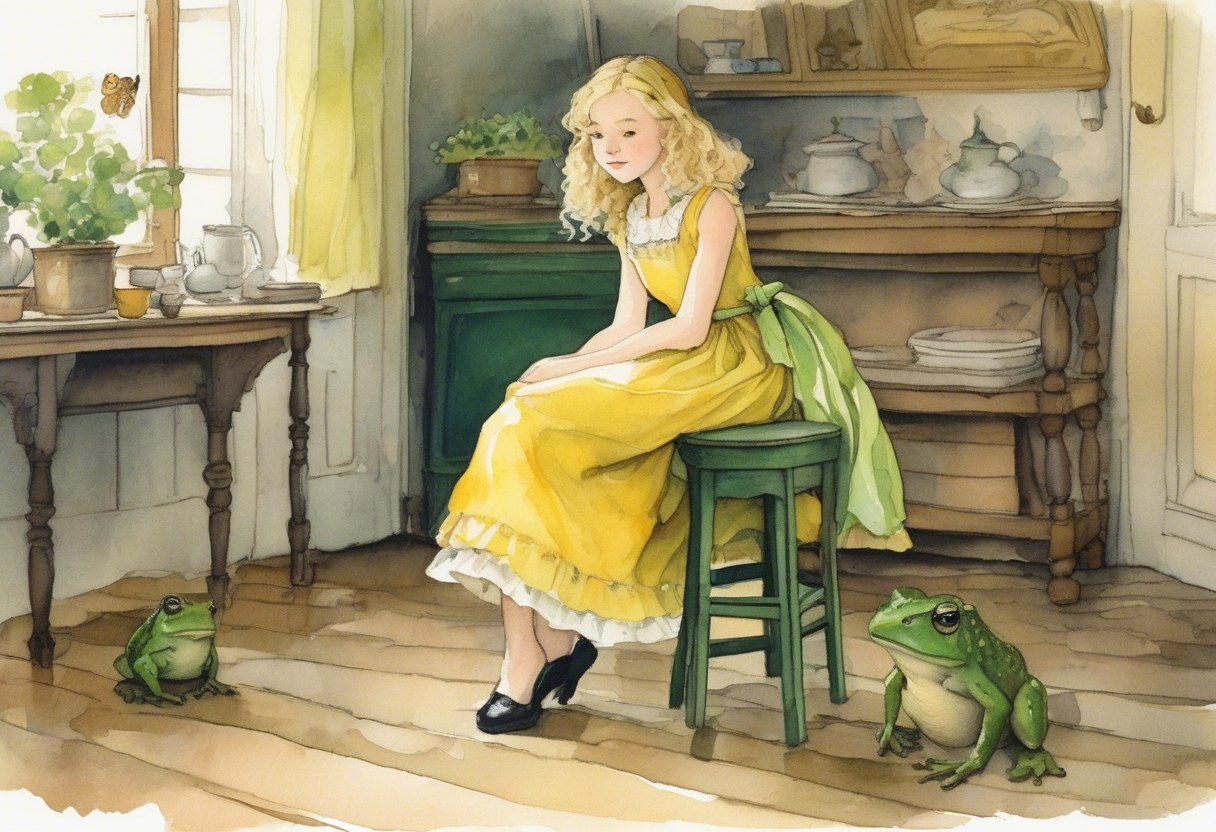
At home, the stepmother and Gunhild gathered around the table. They had no patience to wait, and Gunhild tore open the lid. Out hopped toads, big and small, wet and green-brown, straight up into her face. They splashed in the porridge pot, jumped into the stepmother's shoes and croaked so loudly that everyone's ears ached. Gunhild screamed and jumped up onto a stool. The stepmother shouted for the broom. Her father and Ragna stood in the doorway, trying to keep straight faces, but it was impossible.
When it was quiet again, Gunhild sat on the stool, red in the face. "I was horrid to them all," she said at last, more softly than anyone had ever heard her speak. "And they never did anything to me." Ragna handed her a dry cloth and a piece of bread, and then the two of them helped each other gather the toads into a bucket and carry them down to the pond. There they leapt in with little plops, and Gunhild watched them go.
From that day on, Gunhild was not the same. She learned to carry water, to light the stove and to say thank you. And in the woods behind the house you could sometimes hear a deep, distant rumbling that might have been the wind, and a crow laughing out loud.
Snip, snap, snout, this tale's told out.
Freely retold after Edvard Langset: Folke-eventyr frå Nordmør (1921).
This tale was written with the help of artificial intelligence (Gemini) and illustrated with Stable Diffusion XL. Every tale is checked for child-friendly content before it appears here.