The elf waterfall that hid the summer
Who is in the tale?
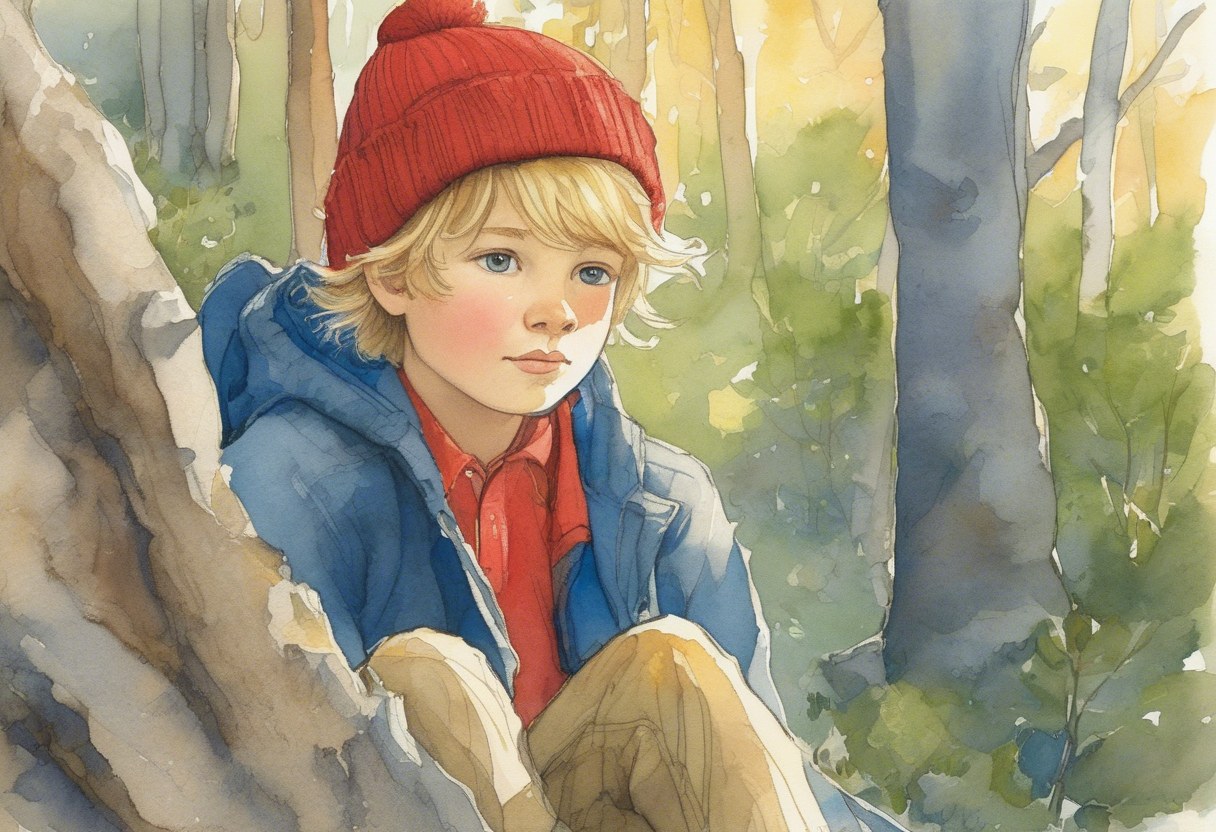
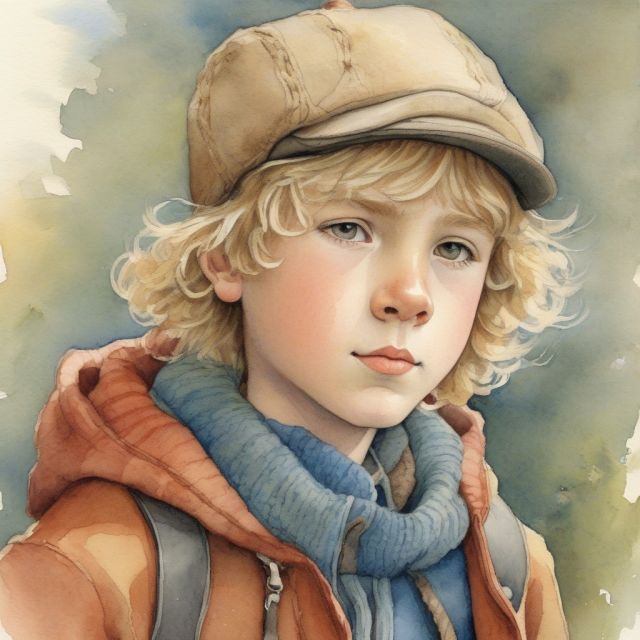 AskeladdenCurious boy who finds the hidden path and saves the sunbeams
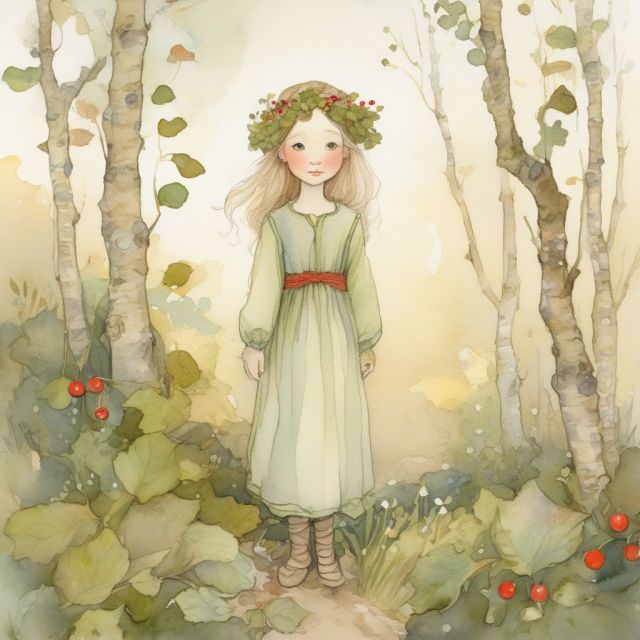 LyngdisTiny elf keeper guarding summer's last sunbeams
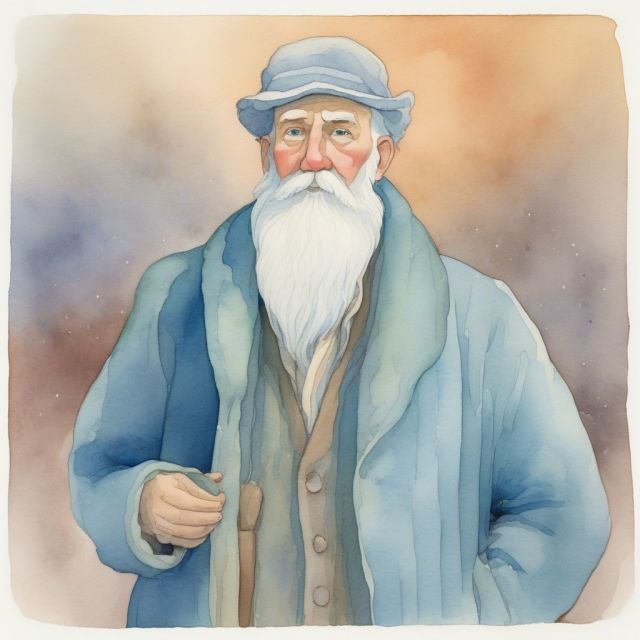 RimgubbenOld frost man who brings autumn but is really just cold and lonely
The path that wasn’t there
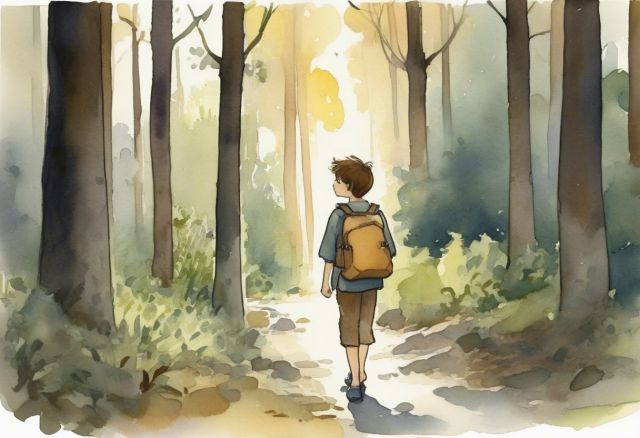
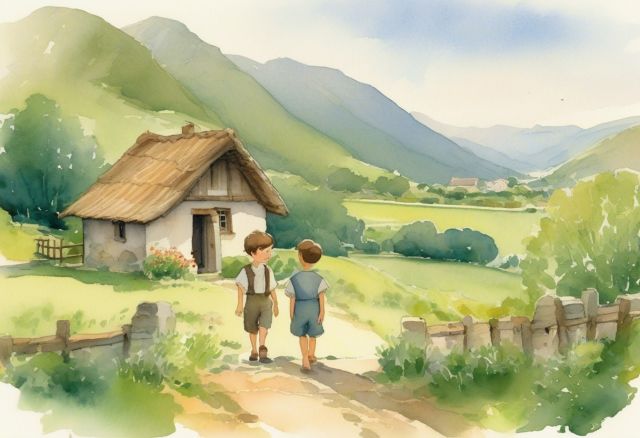
It was late August in Innerdalen, that time of year when the birch leaves begin to grow tired of their green, and the mornings smell cold and clear. The Ash Lad had been sent up the valley with two buckets. Mother wanted bilberries and lingonberries for the winter, and he wasn’t to come home until the buckets were full. Innerdalstårnet rose above him like a sharp grey tooth against the sky. Down on the valley floor the lake lay shining like a mirror, and the mountains stood all around it, watching themselves.
The Ash Lad picked and picked, and his fingers turned blue. His pockets were as full as the buckets, for he was never one to walk past anything odd. There was a rusty iron hook he had found beside an old stable, a piece of twine several metres long, a bird’s feather, and a flat grey stone with a hole right through it. He had found that last one in the river, and he couldn’t have said why he liked it best.
Towards evening the sun sank low, and the light turned golden as butter. Then he saw something strange. All the light in the valley grew fainter and fainter, but one thin beam stayed just as strong. It slid over the heather like a yellow thread and vanished behind the foot of the Tower, between two great boulders.
“That’s odd,” the Ash Lad said to himself. “Sunbeams don’t usually creep under rocks.”
He set down his buckets and followed the thread. Behind the boulders there was nothing but thick juniper and stone, and no path to be seen. But when he lifted the stone with the hole to his eye and peeked through, something curious happened. Between the juniper bushes lay flat stones in a row, covered in moss and glistening like wet shells. A path! It had been there all along, but only the curious ever caught sight of it.
The waterfall with light in its drops
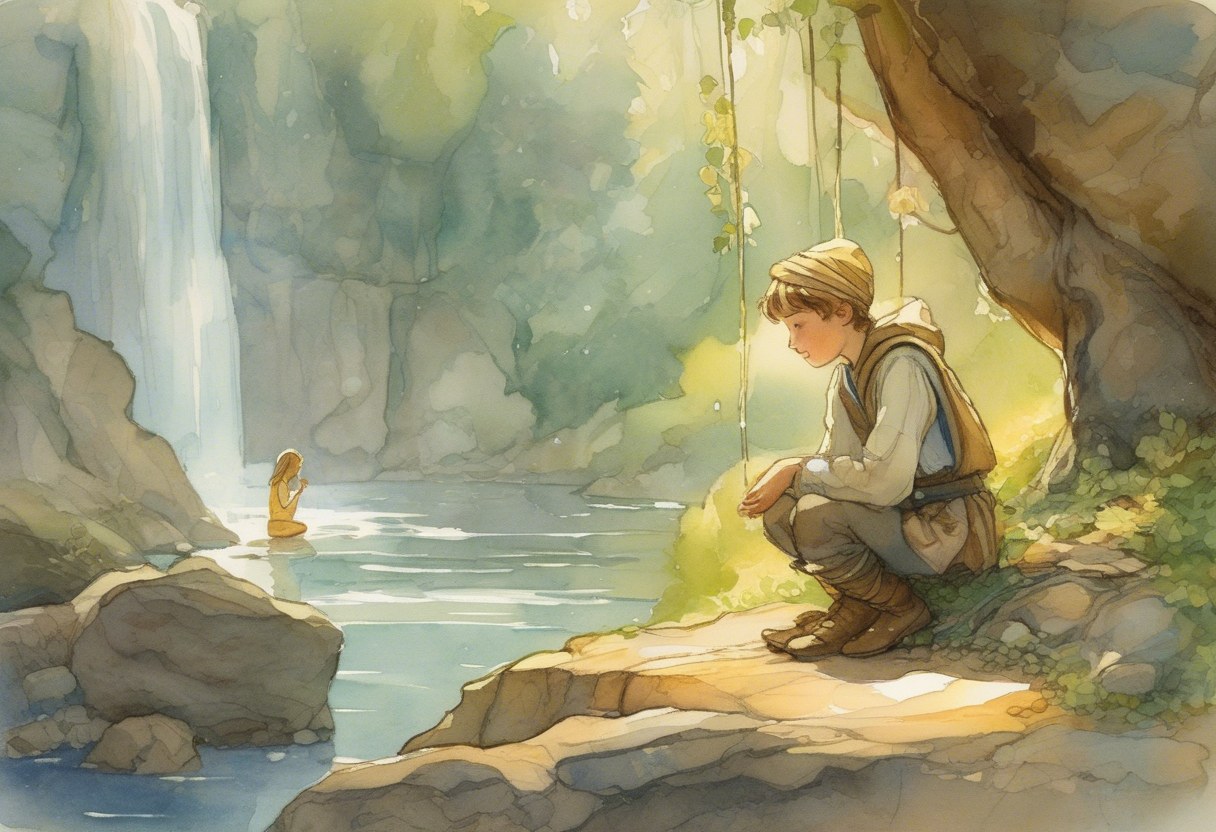
The path wound up and into a narrow gorge. At first the Ash Lad heard only a hiss, then a low, friendly rumble, and then the gorge opened out. There, hidden behind the Tower, a slender waterfall tumbled down a black rock wall. And the water was no ordinary water. Every drop shone like a tiny lantern, yellow and warm, and light came running down the mountainside.
On a ledge in the rock hung hundreds of little cups made of birch bark, hung up on rowan twigs. In every cup lay a glittering sunbeam, folded up like a golden ribbon. It smelled of sunshine and warm grass, though the air was cold.
“Don’t come any closer!” squeaked a voice. “You’re stepping on the little one!”
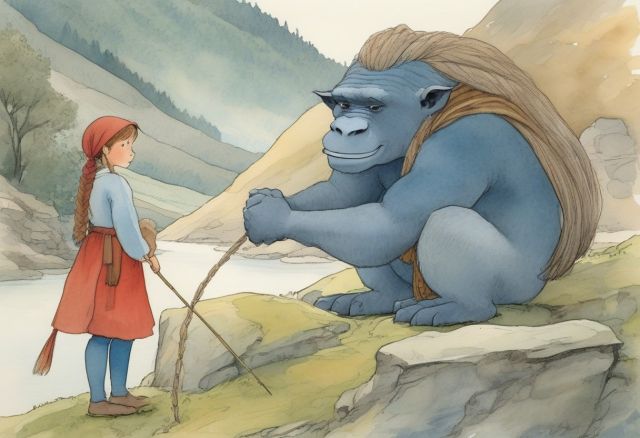
The Ash Lad froze. On a mossy edge sat a tiny woman, no taller than a lingonberry sprig. Her hair looked like dry moss, her dress was sewn from birch leaves, and her nose was as red as a rowanberry. She was crying so hard that the tears came rolling down.
“My name is Lyngdis,” she sniffled, “and I keep watch over the last sunbeams of summer. You’re a human, and humans never find their way here. How did you come?”
“I looked through a stone,” said the Ash Lad, and he showed it to her. “Why are you crying?”
Lyngdis wiped her nose on a birch leaf. She told him that every year the elves gather the last sunbeams in the waterfall, where they stay fresh. Before the first frost they must be carried up to the top of the Tower and laid in a crack in the mountain. There they sleep all through the winter, and when spring comes, they wake the sun. But last night the storm had flung an enormous pine log across the waterfall. Now it was holding back the water, and the light in the cups was growing fainter with every hour.
“The frost comes tonight,” she whispered. “If it touches the sunbeams before they are safe in the mountain, they will turn grey as ash. Then spring will be late, and perhaps it will never fully come at all. And we are so small and light. Not one of us can shift that log.”
The log in the river
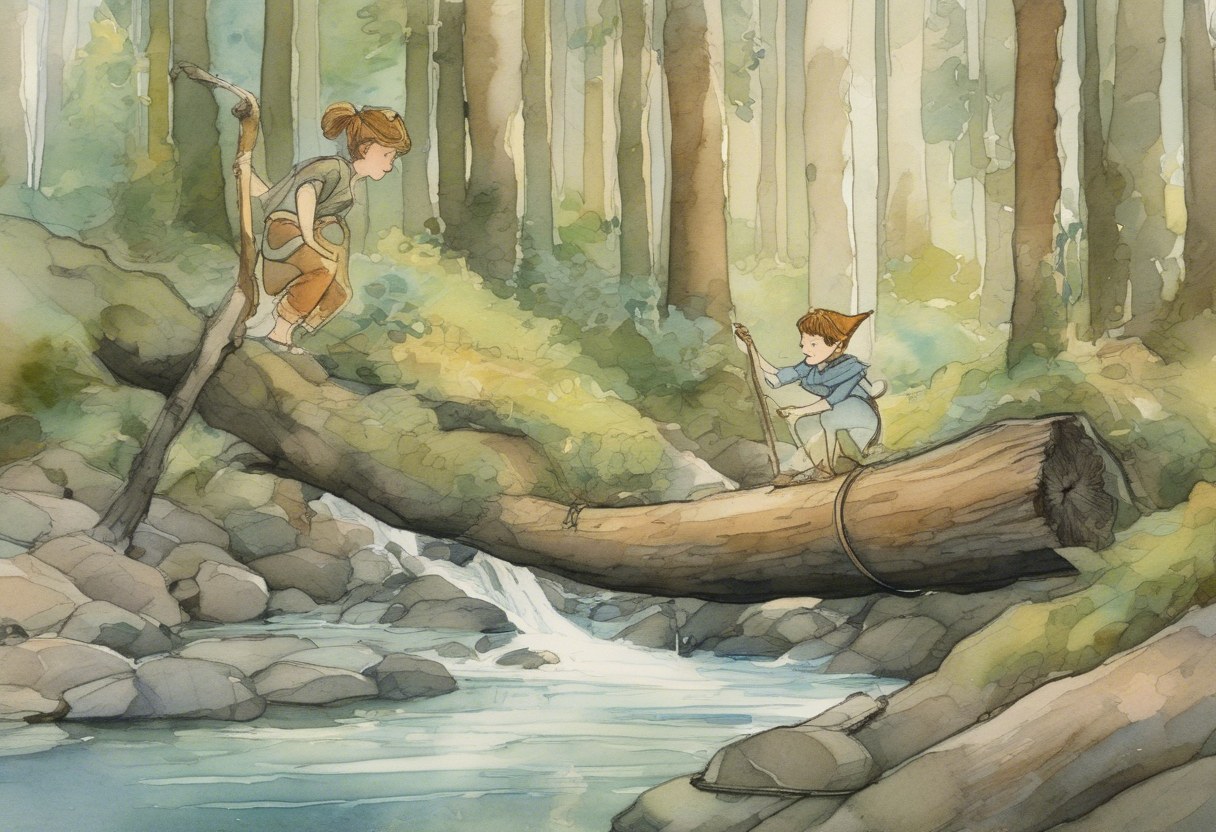
The Ash Lad looked at the log. It lay wedged tight in a cleft, thick as a barrel and grey with old bark. He scratched his head. Per would surely have said he’d lift it with his bare hands, but the Ash Lad knew that Per would have ended up with a sore back and a great deal of boasting, and the log wouldn’t have moved an inch.
“You must use your head first and your arms afterwards,” he muttered, and he took out what he had in his pockets. He hammered the iron hook firmly into a crack in the rock, tied the twine to it, and threw the other end over the log. Then he broke off a long, tough birch pole and set it under the end of the log as a lever.
“Now everyone who can, take hold of the string!” he called.
From every nook and cranny the elves came creeping, hundreds of them, small as ants and carrying lanterns of glowing drops. They took hold of the twine in a long line, with Lyngdis at the front. The Ash Lad put all his weight on the birch pole.
“Heave!” he cried. “And heave!”
The log creaked, gave a little, and creaked again. Then it came loose with a crash and rolled down into the river. The water rushed free, and the waterfall sprayed light as never before. The cups on the ledge began to glow more brightly, and the elves danced all around, clapping their tiny hands.
But that wasn’t the end of it. Now the sunbeams had to be taken to the top. They carried the cups in a long line up the steep path, and the Ash Lad walked at the back, keeping watch. Then a mist rose up from the lake. It came thick and white, and soon nobody could see their own hands. The elves stopped and squeaked in confusion.
The Ash Lad took out the stone with the hole and peeked through. In the mist the sunbeams glowed like golden threads, and between them the path lay as clear as day.
“Follow me,” he said. “I can see the way.”
Old Man Frost on the edge
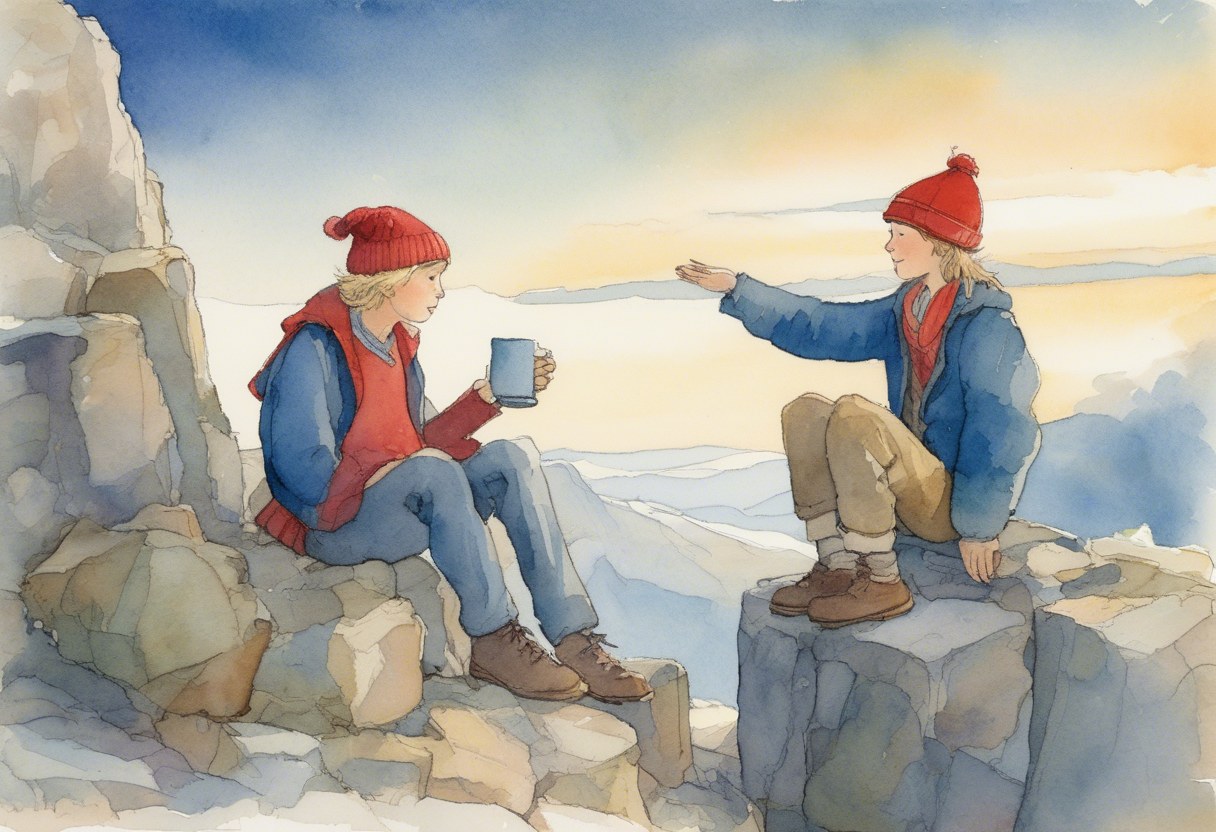
High up, just below the top of the Tower, they found a narrow ledge of rock. An old man stood there, waiting. He was tall and thin, with a beard of white rime that made a crackling sound, and a nose that was blue and red with cold. Every time he breathed out, tiny ice crystals blew from his lips. And the foremost cups had already begun to turn grey at the edges.
“Old Man Frost,” whispered Lyngdis, and she crept in behind the Ash Lad’s boot.
“I am only doing my job,” said the old man, in a voice like the creaking of snow. “Autumn is my time. I come when I come, and I cannot wait.”
The Ash Lad was about to say something, but stopped. He had noticed that the old man was shivering, and that his fingers were white and stiff. And he noticed something else too: Old Man Frost was looking at the glowing cups with a look that was not wicked, but hungry and sad.
“Are you cold?” asked the Ash Lad.
The old man fell silent. “I have always been cold,” he said at last. “Everything I touch turns to ice. No one has ever given me anything warm.”
Then the Ash Lad thought it over. He had no sword and no magic. But he had a hat, knitted by Mother, thick and red and warm from his head. It cost him a little to take it off, for it was a fine hat. But he held it out.
“Would you like to borrow it?”
Old Man Frost took it as if it were made of glass. He pulled it down over his blue ears, and look: his cheeks grew less blue, and a small, astonished smile appeared in his white beard.
“This is the warmest thing I have ever owned,” he said quietly. “I shall keep away from the top of the mountain until midnight. I shall only blow down in the valley. Hurry now.”
The warm stone
At the very top of the Tower the elves found the crack. One by one they lifted the cups inside, and the Ash Lad helped with the heaviest. In there in the rock the sunbeams settled down side by side, and the mountain shone like a lantern. For a moment the whole top of the Tower glowed gold, and people down in the valley saw it and thought it was the sunset, though the sun had long since gone.
When the last cup was in place, Lyngdis came and stood in front of the Ash Lad. She was so small that she had to look straight up.
“You have saved the summer,” she said. “And you gave your hat to Old Man Frost himself. That was just as brave as lifting the log. Here.” She held out a little round stone, grey and smooth. When he laid it in his hand, it was as warm as a freshly baked loaf. “It will stay warm even on the darkest winter day. It is a piece of the sun, just for you.”
The Ash Lad thanked her and put the stone in his pocket with the hook, the twine, the feather and the stone with the hole. Then he walked down into the dark. The path lay clear before him, for now he could see it even without looking through anything. The stars came out, and he found his buckets where he had left them, still full of berries.
Mother was standing on the step with a lantern, shaking her head when he came, for he had been gone a long time. He told her what had happened, but she only smiled and said he could tell such tales to the little boys. All the same, she noticed that his pocket was warm, and that he never once shivered all that evening.
The next morning there was frost on the grass, white and shining, but only down in the valley. And on the doorstep lay the red hat, clean and dry, with tiny, delicate frost flowers stitched along the edge by someone far better at sewing than at freezing. The Ash Lad put it on and went out into the morning chill with a warm stone in his pocket.
Every spring since then, the people of Innerdalen have wondered at how early the sun comes up over the Tower. They say it is just chance. But the Ash Lad knows better. And if the tale isn’t over, then the waterfall with light in its drops is hanging there still.
This tale was written with the help of artificial intelligence (Gemini) and illustrated with Stable Diffusion XL. Every tale is checked for child-friendly content before it appears here.